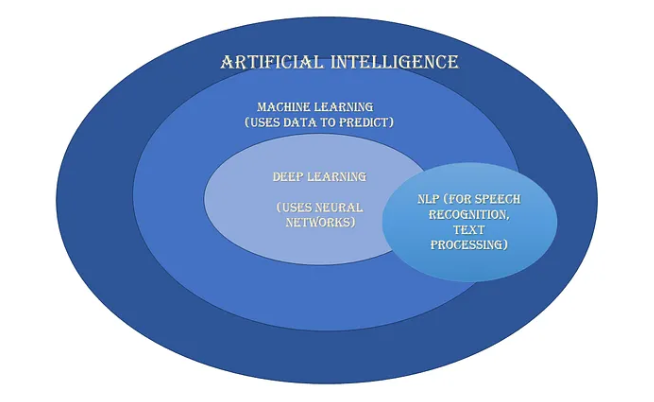
The following are some of the key subfields of AI:
Machine Learning (ML) : Machine learning is a subfield of AI that involves the development of algorithms that can learn from data and improve their performance over time. ML is a crucial aspect of AI, as it enables machines to learn from experience and make predictions or decisions.
Natural Language Processing (NLP) : NLP is a subfield of AI that deals with the interaction between computers and humans in natural language. It involves the development of algorithms and statistical models that enable computers to understand, interpret, and generate human language.
Computer Vision : Computer vision is a subfield of AI that involves the development of algorithms and statistical models that enable computers to interpret and understand visual data from images and videos.
### Interconnections between Subfields
While these subfields are distinct, they are interconnected and often overlap. For instance:
Machine learning is used in NLP to enable computers to understand and generate human language.
Computer vision relies heavily on machine learning algorithms to interpret and understand visual data.
NLP can be used in computer vision to enable computers to understand the context and meaning of visual data.
### Applications of AI Subfields
The key subfields of AI have numerous applications across various industries, including:
Virtual Assistants : NLP is used in virtual assistants like Siri, Alexa, and Google Assistant to understand voice commands and respond accordingly.
Image Recognition : Computer vision is used in applications like facial recognition, object detection, and image classification.
Predictive Maintenance : Machine learning is used in predictive maintenance to analyze sensor data and predict when equipment is likely to fail.
### Summary
In summary, the key subfields of AI, including machine learning, natural language processing, and computer vision, are interconnected and have numerous applications across various industries. Understanding these subfields and their interconnections is crucial for developing and applying AI solutions in real-world contexts.
### Key Takeaways
Machine learning, natural language processing, and computer vision are key subfields of AI.
These subfields are interconnected and often overlap.
● The applications of AI subfields are numerous and varied, including virtual assistants, image recognition, and predictive maintenance.
Machine Learning (ML) : Machine learning is a subfield of AI that involves the development of algorithms that can learn from data and improve their performance over time. ML is a crucial aspect of AI, as it enables machines to learn from experience and make predictions or decisions.
Natural Language Processing (NLP) : NLP is a subfield of AI that deals with the interaction between computers and humans in natural language. It involves the development of algorithms and statistical models that enable computers to understand, interpret, and generate human language.
Computer Vision : Computer vision is a subfield of AI that involves the development of algorithms and statistical models that enable computers to interpret and understand visual data from images and videos.
### Interconnections between Subfields
While these subfields are distinct, they are interconnected and often overlap. For instance:
Machine learning is used in NLP to enable computers to understand and generate human language.
Computer vision relies heavily on machine learning algorithms to interpret and understand visual data.
NLP can be used in computer vision to enable computers to understand the context and meaning of visual data.
### Applications of AI Subfields
The key subfields of AI have numerous applications across various industries, including:
Virtual Assistants : NLP is used in virtual assistants like Siri, Alexa, and Google Assistant to understand voice commands and respond accordingly.
Image Recognition : Computer vision is used in applications like facial recognition, object detection, and image classification.
Predictive Maintenance : Machine learning is used in predictive maintenance to analyze sensor data and predict when equipment is likely to fail.
### Summary
In summary, the key subfields of AI, including machine learning, natural language processing, and computer vision, are interconnected and have numerous applications across various industries. Understanding these subfields and their interconnections is crucial for developing and applying AI solutions in real-world contexts.
### Key Takeaways
Machine learning, natural language processing, and computer vision are key subfields of AI.
These subfields are interconnected and often overlap.
● The applications of AI subfields are numerous and varied, including virtual assistants, image recognition, and predictive maintenance.


Class Sessions
1- Define artificial intelligence (AI) and its relationship to machine learning
2- Identify the roots and milestones in the history of artificial intelligence
3- Explain the differences between narrow or weak AI, general or strong AI, and superintelligence
4- Describe the types of problems that AI can solve, including classification, clustering, and decision-making
5- Recognize the applications of AI in various industries, such as healthcare, finance, and transportation
6- Discuss the benefits and limitations of AI, including job displacement and bias
7- Identify the key subfields of AI, including machine learning, natural language processing, and computer vision
8- Explain the concept of machine learning and its role in realizing AI capabilities
9-
10-
11- Identify the types of machine learning algorithms, including decision trees, support vector machines, and neural networks
12- Define what machine learning is and its importance in artificial intelligence
13- Identify the types of machine learning: supervised, unsupervised, and reinforcement learning
14- Analyze the importance of data quality and preprocessing in AI and machine learning
15- Explain the differences between supervised and unsupervised learning
16- Describe the concept of model training, validation, and testing in machine learning
17- Identify the key steps involved in the machine learning workflow: problem definition, data preparation, model training, model evaluation, and deployment
18- Explain the concept of overfitting and underfitting in machine learning models
19- Describe the importance of feature scaling and normalization in machine learning
20- Identify and explain the types of supervised learning: regression and classification
21- Explain the concept of cost functions or loss functions in machine learning
22- Describe the role of bias and variance in machine learning models
23- Define the importance of data preprocessing in machine learning and its impact on model performance
24- Describe the importance of data preprocessing in machine learning
25- Identify and describe different types of noise in datasets
26- Explain the concept of data cleaning and its techniques, including handling missing values and outliers
27- Apply feature scaling techniques, including logarithmic scaling and standardization
28- Explain the concept of feature selection and its importance in machine learning
29- Implement feature selection using correlation analysis and recursive feature elimination
30- Describe the concept of dimensionality reduction and its importance in machine learning
31- Identify and describe the importance of data transformation in machine learning
32- Apply data transformation techniques, including encoding categorical variables and handling non-linear relationships
33- Implement dimensionality reduction techniques, including PCA and t-SNE
34- Define supervised learning and its importance in machine learning
35- Explain the difference between regression and classification problems
36- Identify and describe the types of regression problems (simple and multiple)
37- Explain the concept of overfitting and underfitting in regression models
38- Describe the concept of classification and its types (binary and multi-class)
39- Explain the concept of bias-variance tradeoff in supervised learning
40- Design and implement a supervised learning model to solve a real-world problem
41- Compare and contrast different supervised learning algorithms (e.g. linear regression, logistic regression, decision trees)
42- Define unsupervised learning and its applications in real-world scenarios
43- Explain the concept of clustering and its types (hierarchical and non-hierarchical)
44- Identify the characteristics of a good clustering algorithm
45- Implement K-Means clustering algorithm using a programming language like Python
46- Evaluate the performance of a clustering model using metrics such as silhouette score and Calinski-Harabasz index
47- Explain the concept of dimensionality reduction and its importance in data analysis
48- Describe the difference between feature selection and feature extraction
49- Implement Principal Component Analysis (PCA) for dimensionality reduction
50- Apply t-Distributed Stochastic Neighbor Embedding (t-SNE) for non-linear dimensionality reduction
51- Define anomaly detection and its importance in machine learning
52- Identify the types of anomaly detection techniques (supervised, unsupervised, and semi-supervised)
53- Apply AI/ML concepts to a real-world problem to identify a tangible solution
54- Select a suitable problem domain and justify its relevance to AI/ML application
55- Formulate a clear problem statement and define key performance indicators (KPIs)
56- Conduct a literature review to identify existing solutions and approaches
57- Design and develop a custom AI/ML model to address the problem
58- Choose and justify the selection of a suitable AI/ML algorithm and techniques
59- Collect, preprocess, and visualize relevant data for model training and testing
60- Implement data augmentation techniques to enhance model performance
61- Reflect on the limitations and potential future developments of the project
62- Defend the project's methodology, results, and implications in a critical discussion
63- Project: Autonomous Thermal Inspection of 20 Wind Turbines